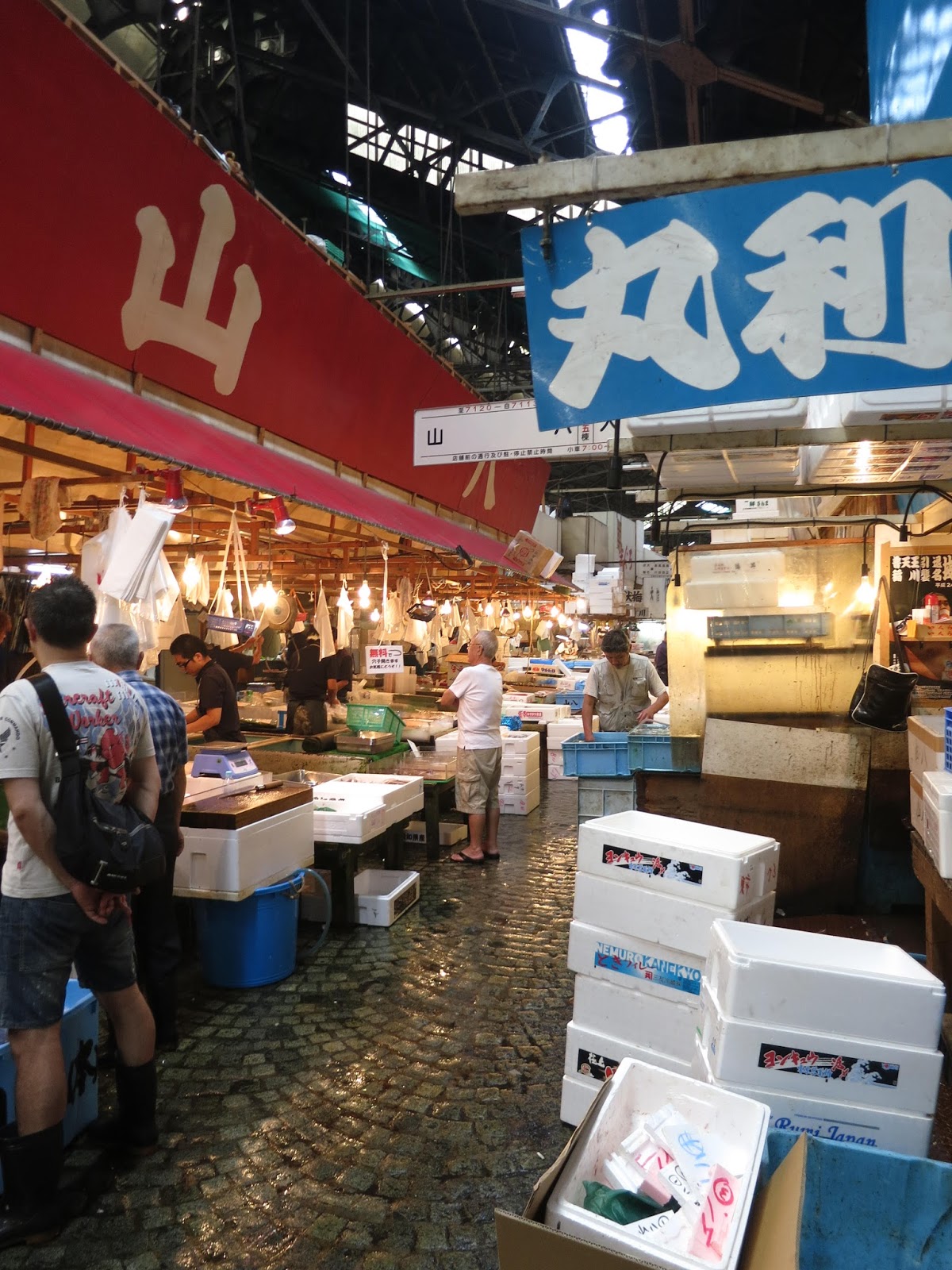
2nd day in Tokyo! We got up early to visit the Tsukiji Fish Market (Tokyo Central Wholesale Market), which is the largest wholesale fish and seafood market in the world. Open 6 days a week from 5a-10a, 15,000 restaurateurs and food sellers buy 450 types of sea produce from 1,700 different stalls. We were tired from the day before, so we didn't get there at 4:30am to be able to watch the tuna auctions, which apparently are the best attraction. Our experience of Japan so far is that people are very courteous - except at the fish market. There are carts and trucks and wheelbarrows who don't stop for pedestrians cruising through the entire place and you are also likely to get fish guts splattered on you as you are walking through. Understandably of course, as everyone there is working on a deadline for their livelihood. We are lucky that they allow visitors in at all.
Sea Urchin - pretty sure
Fish Roe (eggs)
Despite the fact that we missed the tuna auction, we ran into quite a few very large tuna and tuna remains throughout the market.
If all those dead fish turned off - or on - your appetite, the market area is probably the best place to get some of the freshest sushi around (go figure). We waited in a very long line to eat at what is considered to be the best in the area. I had the yellowtail and fatty tuna, and Kenny surprised me again by getting the special (red tuna, prawn, crab and roe). Although neither he nor I ate much of the roe. Best sushi yet.
Waiting for sushi
Around the market are hundreds and hundreds of vendors selling everything from cured fish, vegetables, drinks, tea, Japanese pottery, really expensive sushi knives and everything in-between. Fun to walk around and look at everything for sale. After we had our fill of fish, we made our way to the last stop on our Tokyo tour. The Imperial Palace - home of the Emperor and his family. Unfortunately, the main grounds are closed on Mondays, but you can still get good views of the palace and some gardens. The grounds were initially developed as early as 1590, however much was bombed in WWII, so the Imperial Palace as it stands now was re-built following the war. The emperor opens the doors of his house to the public on New Years Day and his birthday (December 23rd). The double-arched stone bridge seen in the foreground of the palace is called the Nijubashi, constructed in 1888.
The grounds and gardens are also quite impressive from what I could see from the gates. I am excited to get back and walk the grounds further. Although tranquil and beautiful now, the areas around the palace have been the place of shelter for victims of the 1923 earthquake, ritual suicide of many Japanese war officers in 1945, and of violent protests in the 1950's and '60's.
That's all for now! We move into our house at the end of this week, which I am very excited about, however it means no internet for 1-2 weeks. Boooooo to that. Look for pictures of the house soon!
The title of this post is an ongoing joke between Kenny and I, because inevitably every time we emerge from a subway station, one of us will ask: "Okay, which way do we go?" And of course, all the signs are in kanji, so the other will always respond: "I would tell you, but I can't read kanji!." :) We are getting really good at reading maps and counting blocks. In actuality, a lot of the street signs are in romanji as well (Romen lettering), but street signs are rare and addresses are to a general location and not to the exact address. We returned from a 2 day trip to Tokyo yesterday. What a great city. So much to do - we didn't stress about seeing too much since we can go anytime, as well as the blazing heat and humidity continues - about 100F and humid everyday. Again, I only have great things to say about the train system. It is the easiest thing about getting around Japan. Everything is in romanji lettering and I have an amazing app on my phone that will tell you exactly how to take a train or a combination of trains to anywhere. One thing that I don't believe I have mentioned is how crowded the trains can be. Not many people drive, and why would they with such a reliable train system? This can lead to very crowded trains. But - they will do anything to make sure you get on your train. The picture is of an employee of the train system whose job it is to make sure everyone gets on the train - no matter what it takes. All while wearing white gloves. The video shows what will actually happen during busy times. Best to avoid the train during rush hour unless you are okay with being squished.
The first day in Tokyo, we decided to explore the Ginza. Ginza means "silver place", named after the silver mint that was once there. This area was completely destroyed in a fire in 1872, and re-built by an English architect - since being an area with a focus on the modern, making the area a world leader in commerce, leisure and fashion. Lots of fancy shopping and beautiful buildings in this area. Department stores in Japan are a bit different than in the States. The basement usually has a grocery store of some sort, often with a bakery selling all sorts of delicious breads and sweets. For not having traditional baking ovens in their homes - the Japanese can make some mean baked goods. And again, the sweetness of the desserts is dialed down so much from the States, making it so much more enjoyable. The top few floors of the department stores have restaurants. The fanciness of the restaurants depends on the fanciness of the store. There are usually privately owned discrete shops within the department store as well. There are many of these throughout the Ginza. The Wako Department store was originally built in 1894, and the clocktower is a recognizable symbol of Ginza.
Mikimoto is a very modern, glittery building (the sun was too bright to get a decent picture), and this store is the original producer of cultivated pearls.
Matsuya is another large department store.
This was one of my favorite department stores, because they had one floor dedicated to international boutiques, including my favorite shoe stores. It's good to dream! And, I love seeing all the ready-to-wear clothing from all the designers, even though my clothing collection will probably not have the pleasure of knowing too many of these items. Good to get fashion ideas from, however. :)
We also found some more affordable clothing stores in the Ginza - although Kenny was very sad because the dress shirts are made to fit Japanese men and they were tooooo small for him. Poor Kenny, he will just have to order online!
Also in the Ginza is the Sony Building. Here they have their latest gadgets, video game systems, TV's and cameras (many not released yet) on display and available to try out. We played with some amazing new cameras and computers, as well as tried to play the interactive games - not much luck since they were all in Japanese. ;)
Some more pictures of the Ginza:
A 2nd Christian Louboutin within a few blocks of the department store!
Another attraction near the Ginza is the Kabuki-za Theater. The original building opened in this location in 1889, but was completely re-built in the 1950's after being destroyed by bombings in WWII. Kabuki performances take place here everyday, and is on our list to see another time. Kabuki is classical Japanese dance-drama, known for dramatic make-up and "avant-garde" (bizarre) theater. Originally a daytime entertainment for the masses in Japan, the opening of this theater in 1889 marked the transition of kabuki to large stage, highbrow entertainment.
Kenny really broke out of his shell on this trip when it comes to willingness to try unusual foods. I'm very proud. He ordered the steamed octopus at one place (he and I both thought it would be the pieces of tentacle that we are used to seeing, but it was actually very small, WHOLE octopi). If you can ignore the shape of what you are eating, the sauce was actually very good.
We also ate at a yakitori stand - yakitori meaning skewered, grilled meats on a stick. They will "yakitori" anything, including heart, liver, cartilage, intestine, you name it. Kenny really went out on a limb and ordered the gizzard and tongue. He one-upped me on that one, because those were not my first choices! Here we outside the outdoor stand underneath the train tracks.
The last place we went on our 1st day in Tokyo was the Akihabara Electronics District. This district became what it is now right after WWII. The Japanese army had a surplus of equipment they wanted to get rid of. Students and people of Japan bought the equipment and make radios out of it (which were much in demand at the time), to sell on roadside shops in the same district. Today, of course it is TV's, computers, gadgets, video games, etc. that are sold in 8-9 story stores embellished in loud florescent signs, similar to Times Square in New York. Animae is also popular in this district, and you will see many Japanese girls dressed up as animae characters. Grown men line up to buy the newest animae action figure. There is also a large "seediness" to this area - with porn shops, animae porn and sex shops abundant in the area as well.
Day 2 of Tokyo in the next post, as this one is getting quite long!